 Night Desk
Four Hundred Thirty-Four Milligrams Are Counted. Six Hundred Nine Are Not.
Two capsules a day from a Texas seller. I added up every number printed on the panel, and then I weighed what is left over against the studies behind it.

This is a paid advertisement. Sponsored by WOW MD LLC.

Otis Kendrick is the pen name of this desk.
Every figure on this page about the bottle comes from the seller's own product page, the photograph of its official panel and its published terms, all read again on September 20, 2026.
The customers quoted further down are real and their reviews are public on the seller's own page.
The small pictures beside those quotes are illustrations, not the reviewers.
I spent thirty-one years adding up other people's columns for a living.
Freight bills, mostly, and then payroll.
So when a man at the hardware counter handed me a white bottle last week and asked what I made of it, I did the only thing I know how to do with a label.
I added it up.
Nobody ever adds up a supplement label. It takes eleven minutes.
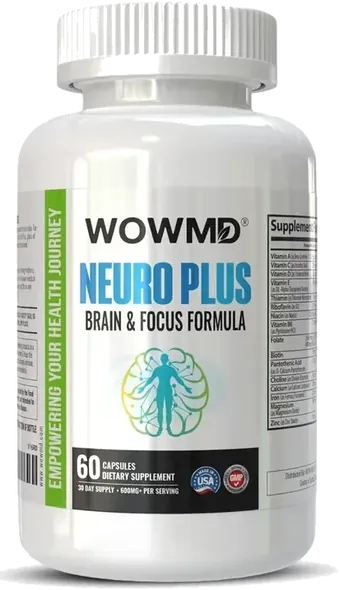
The bottle is Neuro Plus Brain and Focus Formula, sold by WOW MD LLC of Missouri City, Texas.
Sixty vegetable capsules, two a day, which is thirty days.
The back of it carries a Supplement Facts panel like every other bottle on that shelf, and like every other one it has two kinds of lines on it.
The first kind gives you a name and a number. The second kind gives you a name and nothing.
There are twenty-two lines of the first kind on this panel.
There are eighteen names of the second kind, sharing one number between them.
When I added the twenty-two, they came to about 434 milligrams per serving. The eighteen share 609.
That is the whole of this page in one line, and everything below it is the arithmetic, slowly, with the studies laid beside each figure.
Fifty-eight percent of the declared weight of what you swallow has no number beside it.
Not a scandal.
Perfectly legal, extremely common, and something no one ever bothers to work out.
So I worked it out, and then I did the harder half, which is asking what each of those eighteen names would need to weigh for a trial to have anything to say about it.
That is where this page earns its keep, because for most of them the answer is more than the whole blend.
A Panel Is a Promise You Can Check, Until It Isn't
Here is what a printed number on a Supplement Facts panel actually is.
It is a statement to the government about what the seller put in the bottle, and you can hold it against a published trial of the same substance.
A name with no number is a different kind of statement.
It tells you the substance is present and tells you nothing at all about whether it is present in an amount anybody has ever tested.
Both are allowed.
A seller may group ingredients into what the rules call a proprietary blend, print one total weight for the group, and keep the split to itself.
The blend is printed. The split is not.
The usual argument for it is that the recipe is the company's work and a competitor could copy it.
I have no quarrel with that as a business matter, and I am not going to pretend it is sinister.
But the argument has a cost, and the cost lands on you.
A number you cannot see is a number you cannot check against anything.
So my method with this bottle was simple, and it is the same one I would use on a freight bill.
Add the column you can add, then look hard at the line that will not add.

The Column I Could Add
The first half of the panel is a multivitamin, and a fairly complete one.
Twenty-two lines, each with an amount and a percentage beside it, all for two capsules.
Here they are in the seller's own order, and I will keep the units straight as I go.
Vitamin A as beta-carotene, 122 micrograms; vitamin C, 125 milligrams; vitamin D, 3 micrograms; vitamin E, 40 milligrams.
Then the B group: thiamin 3 milligrams, riboflavin 1.7, niacin 12.5, vitamin B6 12 milligrams, folate 680 micrograms from 400 micrograms of folic acid, biotin 3 micrograms, pantothenic acid 12 milligrams.
Then choline, 50 milligrams.
Then the minerals: calcium 20 milligrams, iron 2.6, magnesium 50, zinc 10, selenium 50 micrograms, copper about five hundredths of a milligram, manganese 0.4, chromium 12 micrograms, molybdenum 10 micrograms, potassium 94 milligrams.
That is the column.
Converted to the same unit and totalled, those twenty-two lines come to roughly 434 milligrams per serving.
Vitamin C, potassium, choline, magnesium and vitamin E carry most of that weight between them.
Four hundred and thirty-four milligrams, spread over twenty-two named substances, every one of which you can look up.
That is an ordinary men's multivitamin, more or less.
Not an unusually generous one and not a thin one, with a few lines set high enough to be worth a paragraph of their own further down.
Before I go on, a word about the front of the bottle, because it is the one place the arithmetic gets strange in the seller's favour and against itself at the same time.
The front panel prints "600mg+ per serving."
Six hundred milligrams is the blend.
It is not the serving, which by my column carries about 1,043 milligrams of declared material in total.
The front of the bottle understates its own panel by four hundred milligrams, because the only number it chose to print is the one that cannot be broken down.
I point that out because it tells you what the seller thinks the interesting part is.
The interesting part, to the seller, is the part you cannot check.
Three Lines That Run High, and One That Sits Oddly
Four of the twenty-two counted lines are worth stopping on, and this is the section where a man reading a label ought to slow down.
Three of them are high percentages, and one is a small amount in a bottle aimed at men.
Start with vitamin B6, which the panel gives as 12 milligrams, or 706 percent of the Daily Value.
Seven hundred percent of anything looks like a reason to put the bottle back on the shelf.
It is not, and here the arithmetic is reassuring rather than the opposite.
The Daily Value for B6 is small, 1.7 milligrams, so a modest amount produces a large percentage.
The United States government's Office of Dietary Supplements sets the tolerable upper intake level for B6 at 100 milligrams a day for adults, arrived at by halving the 200 milligrams a day used in studies of up to five years that found no harm. [1]
Twelve milligrams sits well under that.
The same fact sheet is blunt about what happens far higher up: chronic intake of one to six grams a day of oral pyridoxine for twelve to forty months can damage the nerves that carry sensation, with loss of control of bodily movements, and there are several reports of that damage below 500 milligrams a day. [1]
Twelve milligrams is not in that neighbourhood, and I say so plainly because the percentage is designed to make you feel something the number does not justify.
A high percentage is not a high amount. It is a small Daily Value seen through a magnifying glass.
Second line: vitamin E at 40 milligrams, 266 percent.
This one is not a safety question either, but it is an evidence question.
In the Women's Health Study, 6,377 generally healthy women aged 65 or older took 600 international units of vitamin E on alternate days for up to nine and a half years, and the supplement produced no benefit to their thinking over that time. [2]
That is a far larger amount than this bottle carries, given for far longer, in a randomized trial, and it came out flat.
Third: thiamin at 3 milligrams, 250 percent, sitting in a row with riboflavin, niacin, B6, folate and pantothenic acid.
The B group as a group has been tested, and the result is the single most useful thing on this page.
A 2018 Cochrane review pooled fourteen trials covering 27,882 adults whose thinking was healthy at the start, and concluded that B-vitamin supplements, whether folic acid, B12, B6 or combinations of them, probably have little or no effect on overall thinking at any point up to five years. [3]
Twenty-seven thousand people is not a small sample, and a result that large and that flat deserves to be said out loud by the page selling you the bottle.
Twenty-seven thousand eight hundred and eighty-two adults. Little or no effect.
Fourth, and different in kind: iron, 2.6 milligrams, 14 percent.
Iron in a multivitamin is unremarkable in itself, and 2.6 milligrams is a small amount.
It is worth a sentence only because this bottle is advertised to men in their sixties and seventies, who as a group are not the people most multivitamins put iron in for.
I have no trial to hand you about iron and memory and I am not going to invent one; this is simply the line I would point at when I took the bottle to the pharmacy counter.
Those four are the whole of my commentary on the counted half.
The rest of the column is a workaday multivitamin and behaves like one.
The Line That Would Not Add: 609 Milligrams, Eighteen Names
Now the second half, and it is a single line on the panel.
Proprietary Blend, 609 milligrams, followed by eighteen names in a row with not one figure among them.
Here they are, in the seller's order.
DMAE bitartrate, L-glutamine, glutamic acid, green tea leaf extract, bacopa extract, inositol, bilberry fruit extract, GABA, grape seed extract, grapefruit seed extract, olive leaf, cassia bark extract, licorice root extract, boron, DHA at "14 percent," vanadium, phosphatidylserine from soy, and huperzine A from whole herb.
Eighteen names, 609 milligrams, no split.
The first thing any man who has ever divided a bill would do is divide.
Six hundred and nine divided by eighteen is 33.8 milligrams each.
I want to be fair about what that figure is and is not.
It is not what is in the bottle: nobody blends eighteen things in equal parts, and the order of the list usually runs from most to least.
It is a yardstick, and it is the only one the panel leaves you.
If a substance would need more than 33.8 milligrams to match its own trial, then it needs more than its equal share, and the further above the share the trial sits, the harder that becomes.
So that is how I read the rest of the list, one name at a time.
Take the amount the published trial used, and set it beside 33.8 milligrams and beside 609.
One more caution before the list, because it cuts the other way.
A substance can be perfectly well represented at a small amount if the extract is concentrated, and the panel does not print a standardization percentage for anything in the blend.
So even where a name could fit, you are trusting the seller on strength as well as on weight.
That is a reasonable thing to do if you have decided to trust the seller, and it is worth knowing that you are doing it.
What "Extract" and "Whole Herb" Are Doing on This Panel
Two words turn up repeatedly in that list of eighteen, and they are not decoration.
Six of the names carry the word extract, one carries the words whole herb, and both change what a weight means.
Start with extract.
A plant extract is made by soaking the plant in something, drawing out a portion of what is in it, and drying what comes off.
The result can be anywhere from twice to a hundred times as concentrated as the leaf it came from, depending on how it was made and what it was standardized to.
So a milligram of extract and a milligram of dried leaf are not the same object, and the only thing that tells you which you have is a standardization figure.
A standardization figure is a short phrase that reads something like "standardized to 20 percent bacosides" or "24 percent flavone glycosides."
It tells you what proportion of the powder is the part the trial was interested in.
There is no standardization figure anywhere on this panel, on the listing, or on the seller's product page.
That matters more here than it would on a simpler bottle.
The bacopa trials used a standardized extract, and their result belongs to that extract at that strength; an unstandardized bacopa powder at the same weight is a different thing wearing the same name. [4] [5]
Now whole herb, which the panel attaches to two of the eighteen: the bacopa and the huperzine A.
Whole herb usually means the milled plant rather than a concentrate, which points in the opposite direction from extract: less concentrated, not more.
For the bacopa that would make the gap to 300 milligrams of standardized extract wider still, not narrower.
For the huperzine A it is odder, because huperzine A is an isolated compound and a whole-herb club moss preparation is not the same substance as the purified doses used in the study I can quote. [6]
Same word on the label. Different object in the capsule.
I am not going to pretend I can resolve that from the outside, and I will not guess.
What I can say is that the two words most likely to change the meaning of a weight are both on this panel, and neither is pinned down anywhere the buyer can read.
There is a version of this bottle that would settle all of it in three lines of small print: the split of the 609, the standardization of the extracts, and the form of the huperzine A.
None of the three is proprietary in any meaningful sense, and all three are printed by plenty of other companies on the same shelf.
That is the fair criticism of this label, and it is the only one I am prepared to make.
Everything else on the panel is exactly what it says it is.
Bacopa: the Line With Trials in People Your Age
Of the eighteen names, bacopa is the one with the most respectable file behind it in adults over fifty-five.
It is an herb from wet ground in India, used in the traditional medicine of that country for a very long time, and it has been through real randomized trials.
Fifty-four healthy adults aged 65 and older took 300 milligrams a day of a standardized bacopa extract for twelve weeks in one of them.
Forty-eight finished, and they did better than the placebo group on delayed word recall and on a task of ignoring irrelevant information, with no difference on divided attention or immediate working memory; the commonest complaint was an upset stomach. [4]
A second trial gave the same daily amount for the same twelve weeks to ninety-eight healthy adults over 55, of whom eighty-one finished.
Verbal learning, memory acquisition and delayed recall came out better than placebo; other memory and attention measures did not differ, and the extract caused more stomach trouble than placebo did. [5]
A 2014 meta-analysis pulled nine randomized placebo-controlled trials together, 518 people in all, each taking a standardized extract for at least twelve weeks.
It found faster performance on two measures of attention speed and concluded that bacopa has potential, pending a large well-designed trial that has still not been run. [7]
Three hundred milligrams a day, for twelve weeks, standardized.
Now the arithmetic.
Three hundred milligrams is 49 percent of the entire 609-milligram blend, and it is nearly nine times the equal share of 33.8.
For the bacopa in this bottle to reach its own trial amount, it would have to be half the blend on its own, leaving 309 milligrams for the other seventeen names.
Is that possible?
Yes, technically, and the seller has not told anybody whether it is so.
What can be said without guessing is this: the trial amount is not small relative to the blend, and nothing on the label confirms it is reached.
A buyer who wanted bacopa at the amount that has actually been studied could buy bacopa on its own, at a printed amount, for less than this bottle costs.
I say that as plainly as I can, because it is the single most useful sentence on this page for a man who is interested in this herb rather than in this bottle.
It is also, I notice, the sentence the advertisement will never carry.

Huperzine A: the One Name That Fits Many Times Over
Huperzine A is the opposite case, and it is the reason the missing split is more than a debating point.
It is an isolated compound from a club moss, and it is measured in micrograms, not milligrams.
In a placebo-controlled study of healthy adults, twelve to a group, single oral doses of 100 or 200 micrograms inhibited the enzyme it acts on in red blood cells.
The 200-microgram dose maintained declarative recall across sessions, but neither dose improved overall performance on the wider battery. [6]
Two hundred micrograms is two tenths of one milligram.
Against a blend of 609 milligrams, that is about three hundredths of one percent.
Every other name in this blend is fighting for room. Huperzine A could fit three thousand times over.
Which is precisely why its amount is the one I would most want printed.
With a potent compound, the question is never whether there is enough; it is whether there is too much, and the panel does not say.
The blend could hold fifty micrograms of it or five hundred, and both would round to nothing against 609.
Nothing on the label, the listing or the seller's page settles it.
That is not an accusation.
It is an observation about what a total weight can and cannot tell you, and it applies to every proprietary blend on every shelf in the country.
Before going on down the panel, here is the bottle all of this arithmetic comes out of.
The rest of the page keeps going back to its front and its back, so it helps to have it in view.
Phosphatidylserine, DHA and GABA, Set Beside Their Own Trials
Three more names in the blend have published human trials with amounts attached, and all three of those amounts are large.
This is the section where the yardstick does most of its work.
Phosphatidylserine first, listed here as coming from soy.
A six-month double-blind trial gave 100 or 300 milligrams a day to 78 Japanese adults aged 50 to 69 who had memory complaints. [8]
The headline result was flat: scores rose about the same in every group, placebo included.
Only in the subgroup that started with relatively low scores did the phosphatidylserine groups improve from their own baseline, mostly on delayed verbal recall, and the ingredient's maker paid for the work. [8]
The smaller of those two amounts, 100 milligrams, is three times the equal share of this blend.
The larger, 300, is half the blend, which is the same room bacopa would need.
Two names in one blend, each needing half of it.
Then DHA, which the panel lists in an unusual way: "DHA 14 %."
I take that to mean an oil standardized to 14 percent DHA rather than 14 percent of anything else, which would make the DHA itself a fraction of whatever weight the oil occupies.
The trial amounts for DHA are not in the same world as this blend.
A 2015 meta-analysis found that doses above one gram a day of DHA plus EPA improved episodic memory in adults with mild memory complaints, regardless of where their memory started. [9]
One gram is 1,000 milligrams.
That is more than the entire blend, before the other seventeen names get a share of it.
And the evidence above that amount is not tidy either.
A 2012 Cochrane review of three trials in 3,536 adults aged 60 and over found no difference between omega-3 supplements and placebo on a standard mental-status score at 24 or 40 months, and none on word learning, digit span or verbal fluency. [10]
A 2018 review of fifty-one trials concluded that it is still unclear whether long-chain omega-3 fats improve thinking or slow its changes in adults of any age. [11]
So the line reads DHA, the amount is unstated, the amount that has done anything in a trial is bigger than the whole blend, and even at that size the literature disagrees with itself.
Third, GABA.
It is a messenger the body makes in the brain, and the interesting question about swallowing it has always been whether any of it arrives.
In a randomized placebo-controlled experiment in healthy young adults, a single 800-milligram dose produced fewer order errors on a rapid visual attention task and no effect on spatial attention.
The authors called the result preliminary and noted, in print, that whether oral GABA crosses from the blood into the brain is unresolved. [12]
Eight hundred milligrams in that experiment. Six hundred and nine milligrams in this entire blend.
Even if the blend were nothing but GABA, it would fall short of the amount used in the one human experiment I can put in front of you.
That is not a criticism of the seller; it is arithmetic, and it is the reason a blend of eighteen names is a difficult thing to defend line by line.

Green Tea, Glutamine, Inositol and the Six Plant Extracts
That leaves eleven names, and they divide into three groups.
One carries something the panel does not declare, three are substances the body makes in quantity on its own, and six are plant extracts with nothing I can hand you.
Green tea leaf extract is the one with the undeclared passenger.
The United States government's centre for complementary health states that green tea contains caffeine, that injury to the organ that processes what you swallow has been reported in some people who used green tea products, primarily extracts in tablet or capsule form, and that green tea may reduce how well some everyday medicines work, naming three of them. [13]
The panel gives no caffeine figure, and there is no way to work one out from a blend total.
If you are a man who watches his caffeine after four in the afternoon, that is worth a question to the seller before the first capsule, and worth knowing that the instruction on the listing puts these capsules before a meal.
Now the three the body makes for itself.
L-glutamine and glutamic acid sit next to each other near the top of the list, which usually means they are among the heavier items.
Glutamine has traditionally been regarded as a nonessential amino acid: almost every human cell contains the enzyme that makes it, and it turns essential only when the body is under severe strain, such as a major injury.
The clinical studies of supplementing it used about 0.57 grams per kilogram of body weight a day, which is roughly thirty grams for a seventy-kilogram adult under severe strain on the body. [14]
Thirty grams is thirty thousand milligrams.
Set that beside a blend of 609 and the comparison stops being useful, which is itself the point: nobody has tested a pinch of glutamine for memory in a healthy man of sixty-five.
Inositol is the same kind of case.
It was once counted among the B vitamins, but the human body makes it from glucose at up to four or five grams a day, mostly in the kidney, so it is no longer considered an essential nutrient; it is most abundant in fresh fruit, vegetables, beans, grains and nuts. [15]
Four grams a day, made internally, against an unstated share of 609 milligrams taken by mouth.
It is a real substance, present in real food, and there is no sense in which this bottle is your source of it.
Three of the eighteen names are things your own body manufactures in quantities this capsule could not approach, and they occupy room in a blend you are paying for.
Which brings me to the last six: bilberry fruit, grape seed, grapefruit seed, olive leaf, cassia bark and licorice root.
Each of these is a real plant extract with a long history in one kitchen tradition or another, and I could not find a randomized trial of any of them, at any amount, for memory or attention in healthy adults.
I looked, and I am telling you I came up empty rather than borrowing a study about something adjacent.
That is the honest position, and it is the one this page will hold.
Two of them also carry a practical note worth a sentence.
Licorice root is not a thing to take in quantity for months on end without asking someone first, and grapefruit is well known at every pharmacy counter as something that interferes with how the body handles a long list of everyday products, which is one more reason to take this bottle to a pharmacist before you start.
DMAE, the first name on the list, is a choline-like compound with a long shelf history and, as far as I could find, no randomized memory trial in healthy adults to quote.
Boron and vanadium are trace minerals in amounts the blend does not disclose.
Of eighteen names, four have human trials with an amount attached. Three of those four amounts are larger than the entire blend or half of it.
The Lead Notice at the Bottom of the Listing
Scroll far enough down the seller's product page and you come to a short California notice.
It says the product can expose you to chemicals including lead.
I am going to explain this one carefully, because it is the item most likely to be either ignored or misread, and it deserves neither.
California has a law that requires a business to give a clear notice before knowingly exposing anyone to a substance on a long state list, and lead is on that list.
Three things follow from that, and all three matter.
First, the notice is triggered by a state threshold for exposure, not by a measurement anyone has published for this particular bottle.
Second, the thresholds in that law are deliberately conservative, far below the levels used in ordinary food regulation, which is why the notice turns up on a very wide range of products, including plain herbs, cocoa and a great many multivitamins.
Third, lead is present in trace amounts in soil, and therefore in plants grown in soil, and a bottle with a dozen plant extracts in it has a dozen chances to pick some up.
The notice is about a state list and a state threshold. It is not a measurement of this bottle.
What I will not do is wave it away, because the seller chose to print it and you are entitled to weigh it.
What I also will not do is dress it up into something it is not.
The honest reading is this: the presence of the notice tells you the product falls under a California disclosure rule; it does not tell you how much of anything is in a capsule, and the seller has not published a figure.
If that matters to you, the question to put to the seller in writing is simple: do you test finished lots for heavy metals, and will you send me the result for the lot I would receive?
A seller who tests will usually say so gladly.
A seller who does not will give you a general answer, and a general answer is an answer too.
I would ask the same question of any bottle with a dozen plant extracts in it, from any company, and I have asked it of several.
It is not an accusation against this one; it is the sensible question, and the notice at the bottom of the listing is what put it into my head.

Two Sets of Directions, and the Words on the Front
The label and the listing do not tell you the same thing about how to take this, and it is not a small difference.
The photograph of the label says: as a dietary supplement, take two capsules daily with food, or as directed by your healthcare professional.
The listing's own Suggested Use says something else: take two veggie capsules once a day, and for best results take them twenty to thirty minutes before a meal with an eight-ounce glass of water.
With food and before food are not the same instruction.
The label says with a meal and the page selling it says half an hour before one.
Somebody ought to decide which.
For most of the counted half it does not matter much; for the fat-soluble lines, A, D and E, food helps absorption, which argues for the label.
I would follow the printed label, because the printed label is the regulated document, and I would say so to the seller if I called.
Two more things printed on the label belong in this section.
The first is the allergen statement: contains soy and fish, and the fish is named as tuna, which matters to anyone who avoids either.
The second is the description the listing uses for the product category, borrowed from the world of study aids.
Our advertising rules do not permit that word and this page does not print it, which I mention only so you know that what you read on the seller's page and what you read here will not match word for word.
The listing also promises, in its description and in a fair number of its reviews, two things about how a man feels from day to day that this page makes no claim about at all.
I left those reviews out for the same reason I leave the word out.
Who Sells It, and What the Terms Actually Say
The seller is WOW MD LLC, at 4502 Riverstone Building, Suite 1102 #C, Missouri City, Texas.
There is a toll-free number, (800) 986-9321, an email address, store@wowmd.com, and a returns warehouse in West Jordan, Utah.
That is more than some sellers publish and it is the minimum I would want before buying anything from anyone.
A street address, a telephone that rings, and a named legal entity are three facts about who you would be dealing with, and none of them is a fact about the capsules.

I keep those two things apart on purpose, every time.
A company can be easy to reach and forthright about where it sits, and still sell you 609 milligrams of eighteen things with no split printed, and this one does both.
Now the refund terms, which need reading twice.
The seller offers sixty days, and the sixty days apply to the first single-bottle purchase only.
Not sixty days on every order. Sixty days on your first bottle, once.
The published policy says refunds are available only for your first single-bottle purchase, that original shipping charges are not refundable, and that requests are processed within five to seven business days, with no restocking fees.
If you buy three bottles because three is cheaper per bottle, read that sentence again before you click.
Shipping costs nothing above a sixty-dollar order in the United States, which a single bottle does not reach, so a single bottle pays for its own postage.
Delivery runs five to seven business days, and the seller says it ships worldwide with any duties falling on the buyer.
The label prints a good-manufacturing-practice seal and the words Made in USA, and does not name the manufacturer.
That is common and it is not a red flag on its own; it does mean that if you ever wanted to ask who actually made a given lot, the question would have to go through the seller.
This page prints no price, because the seller sets it and changes it, and because a page that quotes a price ages badly.
Look at the price, and at the shipping line for your own address, before you decide anything.
What the People Who Bought It Wrote
The seller's product page carries a review widget that counts 540 reviews with an average of 4.7 stars.
I read the twenty-five the public feed returns, which is the first page of them, and I want to be straight about what I saw.
All twenty-five were written between May and August of this year.
All twenty-five carry a first name and a single initial, twenty-two of the twenty-five carry the seller's mark for a confirmed purchase, and a good many of them are written in a very similar rhythm.
Five hundred and forty reviews counted; twenty-five readable; all twenty-five from one summer.
That is not proof of anything improper and I am not going to suggest it is.
It is a reason to read the 4.7 as a number produced by a widget rather than as a finding, and to read the actual sentences instead, which is what I did.
Here are five of them, word for word, chosen because they carry the purchase mark and because they say different things.
I left out the ones that talk about how a man feels rather than what he did, for the reason given further up.

My wife says I’m less forgetful. That’s a win.

I can read a book for an hour without my mind wandering.

Good quality ingredients. The Bacopa Monnieri is a nice touch.

I feel more articulate and quick on my feet in conversations.

Since starting this, I feel more focused when reading, planning, and handling work, and my mind does not wander off nearly as much as it used to.
Robert D.'s is the one I found most interesting, and not because it is the warmest.
He names the bacopa, which means he read the panel, and the panel does not tell him how much bacopa he is getting.
Individual experiences are not evidence, and nobody in that list was measured on anything.
They are what five people wrote after paying for a bottle, which is worth something and is not worth what an advertisement usually pretends.
The Cheaper Explanations, Taken First
Every page like this one ought to have a section it does not benefit from, and this is mine.
Before a man spends money on any bottle for his memory, there are four ordinary things that cost nothing and explain a great deal more of it than a capsule ever will.
Water is the first, and it is the one I see missed most often.
In the Berlin Aging Study II, 1,111 adults aged 60 to 89 were followed over time, and the third of them who were measurably short of water declined faster on a processing-speed test and in wellbeing than the rest, independent of their circumstances and physical health. [16]
A 2021 systematic review of eighteen studies covering 33,707 adults aged 60 and over reached the same general place: being short of water in later life travels with worse outcomes across the board, with some but sparse evidence tying it to poorer performance on thinking tests. [17]
Both are observational and neither proves cause, and a glass of water costs nothing at all to try.
The second is the shape of what you eat over years rather than what you ate today.
In a three-year randomized trial, 604 older adults with healthy thinking were put either on the MIND eating pattern, which is vegetables, berries, nuts, whole grains, beans, fish and olive oil, or on a control diet with mild calorie restriction, and both groups improved by about the same amount. [18]
I include that one precisely because it came out even.
The pattern is still the best-supported thing on this page, and the trial is a useful correction to anybody who tells you a diet is a lever you pull.
The third is the hour of the day you are judging yourself at.
A man who tests his own memory at nine at night after a long day, and again at nine in the morning with coffee in front of him, will get two different answers and neither is about a capsule.
The fourth is the yearly conversation with a pharmacist about everything you take, this bottle included.
That conversation is at no charge in most places, takes ten minutes, and is the single most useful thing in this entire article.
- Drink water through the day, and notice whether the bad afternoons are the dry ones. [16] [17]
- Move the shape of your eating toward vegetables, beans, nuts, whole grains, fish and olive oil, over months, not days. [18]
- Judge yourself at the same hour, not at the end of a long evening.
- Walk most days, and keep talking to people; conversation is exercise for memory.
- Once a year, put everything you take into one bag and hand it to your pharmacist.
- Ask your own clinician for a B12 level if nobody has checked it in a few years; the stomach absorbs less of it with age. [19]
None of that is sold by anybody, including us.
It is here because a page that only sells you a bottle is not worth the eleven minutes you have already given it.

What a Fair Thirty-Day Test Would Look Like
Suppose you read all of the above and decide to try it anyway.
That is a reasonable thing to do with thirty days and a modest sum, and it deserves a method rather than a shrug.
Buy one bottle, not three.
The refund terms cover the first single bottle and nothing else, so one bottle is both the cheap test and the only one the seller's terms protect.
Take the bottle to your pharmacist before the first capsule, in the bag with everything else you take.
Ask about the green tea extract, about the grapefruit seed, about the licorice root and about the iron, which are the four lines I would want a professional eye on.

Decide which set of directions you are following, the label's or the listing's, and then do not change it for thirty days.
A test with two methods in it is not a test.
Pick your hour and keep it.
Write one line a day, at the same time, about one specific thing rather than a general feeling: whether you needed the shopping list, whether the name came, how the afternoon went.
Thirty lines in a notebook, written at the same hour, will tell you more about this bottle than five hundred and forty stars will.

And set the expectation where the evidence puts it, which is low.
Twenty-seven thousand eight hundred and eighty-two adults took B vitamins in the pooled trials and it came to little or nothing, [3] and the four names in the blend with trials attached are all at amounts this blend cannot obviously reach.
If nothing has changed by day thirty, that is information and not a failure.
Ask for the refund inside the window, in writing, and keep the notebook, because the notebook was always the useful part.
The bottle is sold by WOW MD LLC on its own site, and that is the only place this page sends you.
Everything above came from that site and from the photograph of the label on it.

Every line printed on this panel, with its plain English name, the amount the seller prints for it and the study behind it where one exists, is written out in full in the ingredient guide linked at the foot of this page.
That guide also carries the cautions in full, the complete reference list and the disclosures this page is required to make.
Thirty days of it, from the Texas company that sells it
Two capsules a day of a full multivitamin's worth of vitamins and minerals plus a 609-milligram blend of eighteen plant extracts and nutrients with no amounts printed, from a Texas online seller.
SEE THE PANEL AND THE TERMSSold by WOW MD LLC, Missouri City, Texas · 60 vegetable capsules · two a day · sixty days on a first single-bottle purchase, original shipping not refundable
What men ask me about a panel like this
Is this medicine?
No. It is a dietary supplement: a multivitamin plus a blend of eighteen plant extracts and nutrients, sold by a company in Texas.
What does the 609-milligram line actually tell me?
That those eighteen substances weigh 609 milligrams between them. It does not tell you how much of any single one you are swallowing.
Which line has the best support?
Bacopa, whose trials in adults over 55 used 300 milligrams a day of a standardized extract for twelve weeks. [4] [5] That amount would be about half of the whole blend.
Is 706 percent of vitamin B6 too much?
The percentage is large because the Daily Value is small. Twelve milligrams sits well below the 100-milligram upper level set for adults. [1]
Should I worry about the California lead notice?
It tells you the product falls under a state disclosure rule with very conservative thresholds, not that a figure has been measured for this bottle. Ask the seller in writing whether finished lots are tested.
With food or before food?
The label says with food and the listing says twenty to thirty minutes before a meal. I would follow the printed label and pick one for thirty days.
Does it contain caffeine?
The blend contains green tea leaf extract, which contains caffeine, and no caffeine figure is printed anywhere. [13]
What if I do not get on with it?
You have sixty days on a first single-bottle purchase. Original shipping is not refunded and requests are processed in five to seven business days.
The Whole Panel, Added Up
- A white bottle of sixty vegetable capsules from WOW MD LLC of Missouri City, Texas; two capsules are one serving and the bottle is thirty days.
- Twenty-two lines carry a name and an amount, and together they come to about 434 milligrams a serving: an ordinary men's multivitamin.
- One line carries a name and no amount for each of eighteen substances, sharing 609 milligrams, which is about 58 percent of the declared weight of a serving.
- Divided equally, that is 33.8 milligrams each, which is the only yardstick the panel leaves you.
- Bacopa's trials in adults over 55 used 300 milligrams a day of a standardized extract for twelve weeks: about half the whole blend. [4] [5] [7]
- Phosphatidylserine's trial used 100 to 300 milligrams a day and its headline result was flat against placebo. [8]
- DHA's useful amount in the meta-analysis was above one gram a day, which is more than the entire blend. [9] The larger reviews disagree with each other. [10] [11]
- GABA's single human experiment used 800 milligrams, also more than the whole blend, and whether swallowed GABA reaches the brain is unresolved. [12]
- Huperzine A was studied at 100 to 200 micrograms, so it is the one name that fits many times over, which is exactly why its amount should be printed. [6]
- Six plant extracts in the blend have no randomized memory trial in healthy adults that I could find at any amount, and three more names are substances the body makes in grams a day. [15] [14]
- B vitamins were pooled across fourteen trials in 27,882 healthy adults and came to little or no effect on thinking up to five years. [3]
- Vitamin B6 at 12 milligrams is 706 percent of a small Daily Value and sits well under the 100-milligram upper level. [1] Vitamin E was flat in a nine-year randomized trial at a far larger amount. [2]
- Green tea leaf extract carries caffeine that the panel does not quantify, and the same fact sheet notes reported injury to the organ that processes what you swallow with green tea extracts in capsule form. [13]
- The listing carries a California notice about exposure to chemicals including lead, triggered by a state threshold rather than by a published measurement of this bottle.
- The label and the listing give different directions: with food, or twenty to thirty minutes before a meal.
- Sixty days on a first single-bottle purchase only; original shipping not refunded; shipping at no charge above sixty dollars, which one bottle does not reach.
- Five hundred and forty reviews counted by the widget with an average of 4.7; twenty-five readable, all from one summer, twenty-two carrying a purchase mark, five quoted here.
- Before any of it: water, the shape of your eating over years, the hour you judge yourself at, and ten minutes with a pharmacist. [16] [17] [18]
What Two Capsules Are Worth
Here is the whole thing in one breath, the way I would say it across the hardware counter.
This is a decent ordinary multivitamin with a second, heavier half stacked on top of it that nobody outside the company can measure.
The multivitamin half is checkable and unremarkable, with one line high enough to look up, which I did, and which turned out to be fine.
The other half is where the price and the name live, and it is the half that cannot be held against a single published trial with any confidence.
Four of its eighteen names have human trials with amounts attached.
Three of those four amounts are half the blend or larger than all of it, and the fourth is so small that the only thing worth knowing about it is the number the panel does not print.
You are not buying a bad bottle. You are buying a good multivitamin and a blend whose arithmetic you are asked to take on trust.
If you are a man who wants a multivitamin and is curious about the rest, thirty days and one bottle is a fair, cheap experiment with a refund window around it.
If you are a man who came here because of the bacopa, buy bacopa with a number printed beside it and spend less.
And if you came here worried, the four ordinary things in the section above are where I would start, in that order, before any bottle at all.
That is the honest arithmetic, and it is all I have.
One bottle of sixty, from the seller's own counter
Two capsules a day of a full multivitamin's worth of vitamins and minerals plus a 609-milligram blend of eighteen plant extracts and nutrients with no amounts printed, from a Texas online seller.
SEE THE PANEL AND THE TERMSSold by WOW MD LLC · Missouri City, Texas · 60 vegetable capsules, thirty days · sixty days on a first single-bottle purchase · (800) 986-9321
P.S. If you take two numbers from this page, take 434 and 609.
The first is what the panel counts.
The second is what it does not, and it is the bigger of the two.
P.P.S. Take the bottle to your pharmacist before the first capsule, in the same bag as everything else you take.
Ask about the green tea extract, the grapefruit seed, the licorice root and the iron.
Ten minutes, at no charge, and worth more than the bottle.